
ITA ENG


| ERANOS TAGUNG 2026 | Eclipse of the Dèmos and Betrayals of Democracy
TAG2026
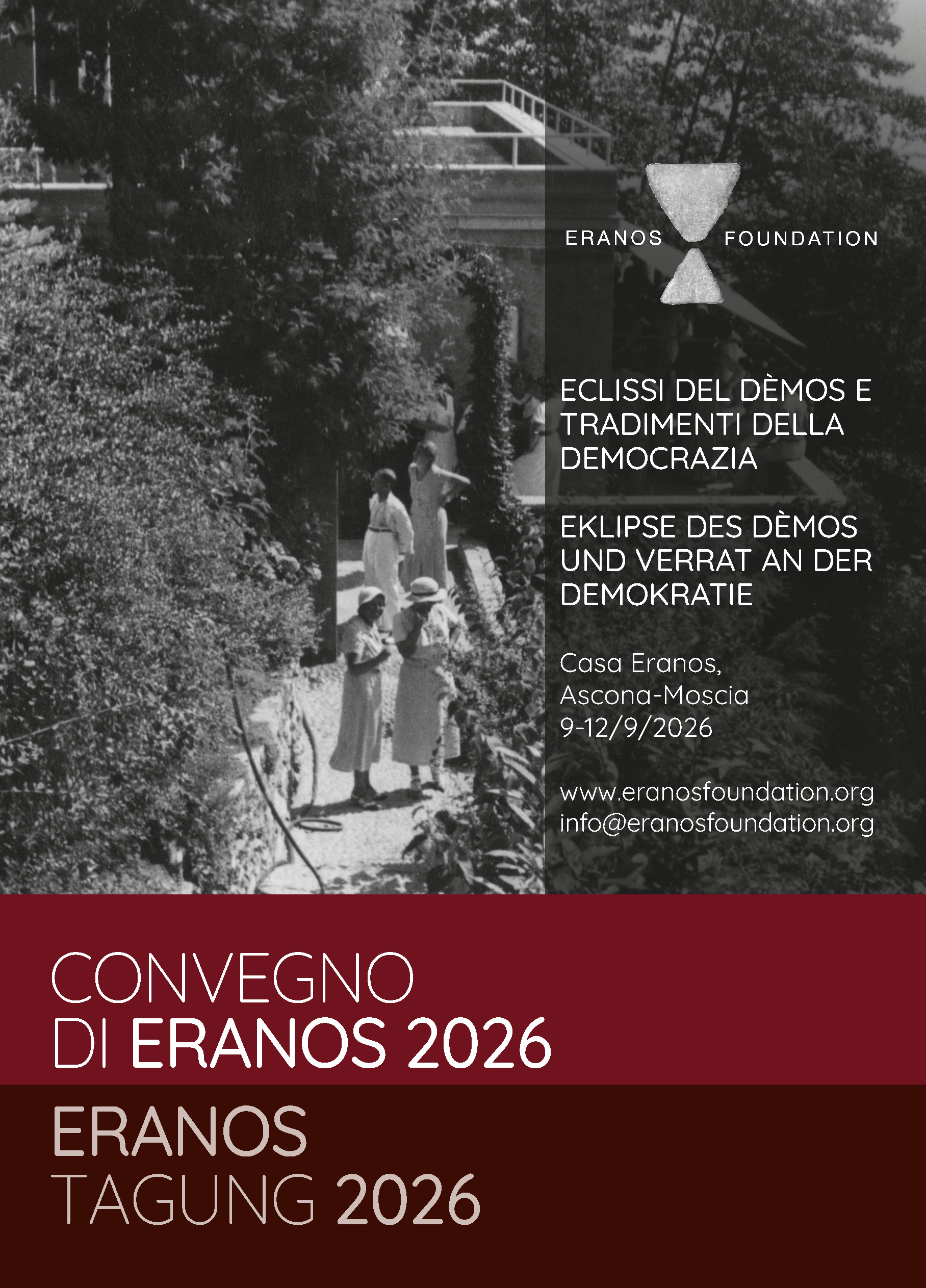
CONVEGNO DI ERANOS 2026: “Eclissi del dèmos e tradimenti della democrazia”
Casa Eranos, Ascona (Svizzera), 9-12 settembre 2026
ERANOS CONFERENCE 2026: 'Eclipse of the Dèmos and Betrayals of Democracy'
Casa Eranos, Ascona (Switzerland), September 9-12, 2026
ERANOS CONFÉRENCE 2026: « Éclipse du dèmos et trahisons de la démocratie »
Casa Eranos, Ascona (Suisse), 9-12 septembre 2026
ERANOS TAGUNG 2026: „Eklipse des Dèmos und Verrat an der Demokratie“
Casa Eranos, Ascona (Schweiz), 9.-12. September 2026
Relatori / Lecturers / Conférencies / Redner
Seminario dottorale coordinato da / Ph.D. Seminar chaired by / Séminaire doctoral coordonné par / Doktorandenseminar koordiniert von
Con la partecipazione dei Docenti ospiti / With the participation of guest lecturers / Avec la participation des professeurs invités / Mit der Teilnahme von Gastdozenten
In partenariato con / In partnership with / En partenariat avec / In Zusammenarbeit mit
Fondation Braillard Architectes
In collaborazione con il Dottorato di ricerca in Studi umanistici transculturali, Università di Bergamo, il Dottorato di ricerca in Filosofia, Università di Pisa e Università di Firenze, il Dottorato di ricerca in Scienze religiose, Facoltà di Teologia di Lugano, il Dottorato di Ricerca in Studi Germanici e Slavi, "Sapienza" Università di Roma e Univerzita Karlova, Praha, e il Dottorato di Ricerca in Mutamento sociale e politico, Università di Firenze e Università di Torino
In collaboration with the Ph.D. program in Transcultural Studies in Humanities, University of Bergamo, the Ph.D. program in Philosophy, University of Pisa and University of Florence, the Ph.D. program in Religious Sciences, Faculty of Theology of Lugano, the Ph.D. program in Germanic and Slavic Studies, 'Sapienza' University of Rome and Univerzita Karlova, Praha, and the Ph.D. program in Social and Political Change, University of Florence and University of Turin
En collaboration avec le Doctorat de recherche en Études humanistes transculturelles, Université de Bergamo, le Doctorat de recherche en Philosophie, Université de Pise et Université de Florence, le Doctorat de recherche en Sciences religieuses, Faculté de Théologie de Lugano, le Doctorat de recherche en études germaniques et slaves, « Sapienza » Université de Rome et Univerzita Karlova, Praha, et le Doctorat de recherche en Changement social et politique, Université de Florence et Université de Turin
In Zusammenarbeit mit dem Doktorandenprogramm für Transkulturellen Geisteswissenschaften, Universität Bergamo, dem Doktorandenprogramm für Philosophie, Universität Pisa und Universität Florenz, dem dem Doktorandenprogramm für Religionswissenschaften, Theologischen Fakultät Lugano, dem Doktorandenprogramm für Germanistik und Slawistik, „Sapienza“ Universität Rom und Univerzita Karlova, Praha, und dem Doktorandenprogramm für Sozialem und politischem Wandel, Universität Florenz und Universität Turin
Presentazione
Una società che fa dell’immediatezza il suo principale alleato, tanto da definire “reale” quel tempo che si afferma annullando se stesso, è una società che crede di poter fare a meno di tutte quelle strutture di intermediazione dove la creazione del valore (economico, sociale, individuale) emerge attraverso la dimensione diacronica del tempo della durata, anziché attraverso quella sincronica dell’istantaneità. In un simile quadro, si impone la questione di quale concezione di dèmos possa ancora risultare plausibile e se sia ancora possibile parlare di “popolo” in senso propriamente politico. Può esserci ancora humanitas (il termine con cui si nomina la solidarietà, la giustizia, l’uguaglianza, il riconoscimento e quindi l’inclusività) là dove l’individualismo delle nostre società sembra essere solo in grado di prestare attenzione alle necessità della particolarità? E senza humanitas può ancora darsi un dèmos così come lo hanno pensato idealmente le democrazie moderne? E ancora: se proprio non è possibile farne a meno, vi è modo di pensare la particolarità senza dover rinunciare all’universalità? Senza dunque cedere alle derive regressive ed esclusiviste dell’éthnos? L’odierna crisi della democrazia riflette l’affermarsi di rivendicazioni identitarie dove le ragioni della divisività fanno premio su quelle della coesione e della mutua responsabilità. Ma là dove una società perde il senso della comunità, quale idea di dèmos può ancora sopravvivere? Naturalmente, ci sono buone ragioni per spiegare questa deriva. La vulnerabilità della democrazia richiede un esercizio di costante manutenzione. I suoi valori o trovano il modo di incarnarsi nelle nostre pratiche di vita o rimangono vuoti simulacri. Non possono, cioè, sopravvivere nel solo regno delle idee. Occorre che essi trovino lo spazio e le risorse per essere agiti quotidianamente. In assenza di ciò, vi è solo risentimento, aggressività e conflitto. Tutto ciò è oggi all’ordine del giorno a diversi livelli del vivere sociale: basti pensare all’impasse in cui è finita l’attività lavorativa, dove alla continua richiesta di incremento della performatività corrisponde una capacità di rappresentanza in costante declino, con appunto tutti gli effetti di fragilizzazione e di rancore che ciò comporta. In questo scenario, la posta in gioco non è semplicemente la tenuta di istituzioni formali, ma la possibilità stessa di ricostruire un orizzonte di senso condiviso in cui il dèmos non coincida né con la somma di individui autoreferenziali né con il ripiegamento identitario dell’éthnos. Se la democrazia vuole sottrarsi alla logica dell’istantaneità e alla frammentazione che ne deriva, deve tornare a investire sul tempo lungo delle pratiche, delle relazioni e delle mediazioni, là dove l’universalità non cancella la particolarità ma la rende intelligibile e comunicabile. L’humanitas, allora, non può essere pensata come un residuo morale di un passato idealizzato, bensì come un compito politico sempre incompiuto, che richiede luoghi, tempi e dispositivi capaci di sostenere l’esperienza della reciprocità e della mutua responsabilità. Solo in questa prospettiva il demos può riacquistare spessore, non come dato immediato o identità chiusa, ma come costruzione storica fragile e continuamente esposta, che vive della cura quotidiana dei suoi legami e della capacità di riconoscere, nel conflitto stesso, una possibilità di coesione e di futuro condiviso.
Presentation
A society that makes immediacy its main ally, to the extent that it defines as 'real' that time which asserts itself by cancelling itself out, is a society that believes it can do without all those intermediary structures where the creation of value (economic, social, individual) emerges through the diachronic dimension of duration, rather than through the synchronic dimension of instantaneity. In such a context, the question arises as to what conception of dèmos can still be plausible and whether it is still possible to speak of 'people' in a strictly political sense. Can there still be humanitas (the term used to refer to solidarity, justice, equality, recognition, and therefore inclusiveness) where the individualism of our societies seems only capable of paying attention to the needs of particularity? And without humanitas, can there still be a dèmos as ideally conceived by modern democracies? And again: if it is really impossible to do without it, is there a way of thinking about particularity without having to renounce universality? Without, therefore, giving in to the regressive and exclusivist tendencies of éthnos? Today’s crisis of democracy reflects the rise of identity claims where the reasons for division take precedence over those of cohesion and mutual responsibility. But where a society loses its sense of community, what idea of démos can still survive? Of course, there are good reasons to explain this drift. The vulnerability of democracy requires constant maintenance. Its values either find a way to be embodied in our practices of life or remain empty simulacra. That is, they cannot survive in the realm of ideas alone. They need to find the space and resources to be acted upon on a daily basis. In the absence of this, there is only resentment, aggression, and conflict. All this is now commonplace at various levels of social life: just think of the impasse in which work has ended up, where the constant demand for increased performance is matched by a steadily declining capacity for representation, with all the effects of fragility and resentment that this entails. In this scenario, what is at stake is not simply the stability of formal institutions, but the very possibility of rebuilding a shared horizon of meaning, in which the démos does not coincide with either the sum of self-referential individuals or the identity-based retreat of the éthnos. If democracy wants to escape the logic of instantaneity and the fragmentation that comes with it, it must return to investing in the long term of practices, relationships, and mediations, where universality does not erase particularity but makes it intelligible and communicable. Humanitas, then, cannot be thought of as a moral residue of an idealized past, but rather as an ever-unfinished political task that requires places, times, and devices capable of sustaining the experience of reciprocity and mutual responsibility. Only in this perspective can the demos regain depth, not as an immediate given or a closed identity, but as a fragile and continuously exposed historical construction, which thrives on the daily care of its bonds and the ability to recognise, in conflict itself, a possibility for cohesion and a shared future.
Présentation
Une société qui fait de l'immédiateté son principal allié, au point de définir comme « réel » ce temps qui s'affirme en annulant soi-même, est une société qui croit pouvoir se passer de toutes ces structures d'intermédiation où la création de valeur (économique, sociale, individuelle) émerge à travers la dimension diachronique du temps de la durée, plutôt qu'à travers celle, synchronique, de l'instantanéité. Dans un tel contexte, la question se pose de savoir quelle conception du dèmos peut encore être plausible et s'il est encore possible de parler de « peuple » au sens proprement politique. Peut-il encore y avoir humanitas (le terme qui désigne la solidarité, la justice, l'égalité, la reconnaissance et donc l'inclusivité) là où l'individualisme de nos sociétés semble seulement capable de prêter attention aux besoins de la particularité ? Et sans humanitas, peut-il encore y avoir un dèmos tel que l'ont idéalement conçu les démocraties modernes ? Et encore : s'il n'est vraiment pas possible de s'en passer, y a-t-il un moyen de penser la particularité sans renoncer à l'universalité ? Sans céder aux dérives régressives et exclusivistes de l'éthnos ? La crise actuelle de la démocratie reflète l'affirmation de revendications identitaires où les raisons de la division l'emportent sur celles de la cohésion et de la responsabilité mutuelle. Mais là où une société perd le sens de la communauté, quelle idée de dèmos peut encore survivre ? Bien sûr, il y a de bonnes raisons pour expliquer cette dérive. La vulnérabilité de la démocratie nécessite un exercice d'entretien constant. Si ses valeurs ne trouvent pas le moyen de s'incarner dans nos pratiques de vie, elles restent des simulacres vides. Elles ne peuvent donc pas survivre dans le seul domaine des idées. Elles doivent trouver l'espace et les ressources nécessaires pour être mises en œuvre quotidiennement. En l'absence de cela, il n'y a que ressentiment, agressivité et conflit. Tout cela est aujourd'hui à l'ordre du jour à différents niveaux de la vie sociale : il suffit de penser à l'impasse dans laquelle se trouve le monde du travail, où la demande constante d'augmentation de la performance correspond à une capacité de représentation en déclin constant, avec tous les effets de fragilisation et de rancœur que cela implique. Dans ce scénario, l'enjeu n'est pas simplement le maintien des institutions formelles, mais la possibilité même de reconstruire un horizon de sens partagé dans lequel le dèmos ne coïncide ni avec la somme d'individus autoréférentiels ni avec le repli identitaire de l'éthnos. Si la démocratie veut échapper à la logique de l'instantanéité et à la fragmentation qui en découle, elle doit revenir à investir dans le temps long des pratiques, des relations et des médiations, là où l'universalité n'efface pas la particularité mais la rend intelligible et communicable. L'humanitas ne peut donc être considérée comme un résidu moral d'un passé idéalisé, mais plutôt comme une tâche politique toujours inachevée, qui nécessite des lieux, des temps et des dispositifs capables de soutenir l'expérience de la réciprocité et de la responsabilité mutuelle. Ce n'est que dans cette perspective que le demos peut retrouver toute sa profondeur, non pas comme une donnée immédiate ou une identité fermée, mais comme une construction historique fragile et continuellement exposée, qui vit de l'entretien quotidien de ses liens et de sa capacité à reconnaître, dans le conflit lui-même, une possibilité de cohésion et d'avenir partagé.
Präsentation
Eine Gesellschaft, die die Unmittelbarkeit zu ihrem wichtigsten Verbündeten macht, so sehr, dass sie jene Zeit als „real“ definiert, die sich selbst aufhebt, ist eine Gesellschaft, die glaubt, auf all jene Vermittlungsstrukturen verzichten zu können, in denen die Schaffung von (wirtschaftlichem, sozialem, individuellem) Wert durch die diachrone Dimension der Dauer und nicht durch die synchrone Dimension der Unmittelbarkeit entsteht. In einem solchen Rahmen stellt sich die Frage, welche Vorstellung von dèmos noch plausibel sein kann und ob es noch möglich ist, im eigentlichen politischen Sinne von „Volk” zu sprechen. Kann es noch humanitas (der Begriff, mit dem Solidarität, Gerechtigkeit, Gleichheit, Anerkennung und damit Inklusivität bezeichnet werden) geben, wo der Individualismus unserer Gesellschaften nur in der Lage zu sein scheint, auf die Bedürfnisse der Besonderheit zu achten? Und kann es ohne humanitas noch einen dèmos geben, wie ihn sich die modernen Demokratien idealerweise vorgestellt haben? Und weiter: Wenn es wirklich nicht möglich ist, darauf zu verzichten, gibt es dann eine Möglichkeit, das Besondere zu denken, ohne auf das Allgemeine verzichten zu müssen? Ohne also den regressiven und exklusivistischen Tendenzen des éthnos nachzugeben? Die heutige Krise der Demokratie spiegelt das Aufkommen identitärer Forderungen wider, bei denen die Gründe für Spaltung Vorrang vor denen für Zusammenhalt und gegenseitige Verantwortung haben. Aber wo eine Gesellschaft den Sinn für Gemeinschaft verliert, welche Idee von dèmos kann dann noch überleben? Natürlich gibt es gute Gründe, die diese Entwicklung erklären. Die Verletzlichkeit der Demokratie erfordert eine ständige Pflege. Ihre Werte müssen entweder in unseren Lebenspraktiken Gestalt annehmen oder sie bleiben leere Scheinbilder. Sie können also nicht allein im Reich der Ideen überleben. Sie müssen den Raum und die Ressourcen finden, um täglich gelebt zu werden. Fehlen diese, gibt es nur Ressentiments, Aggressivität und Konflikte. All dies ist heute auf verschiedenen Ebenen des sozialen Lebens an der Tagesordnung: Man denke nur an die Sackgasse, in die die Arbeitswelt geraten ist, wo der ständigen Forderung nach Leistungssteigerung eine ständig abnehmende Repräsentationsfähigkeit gegenübersteht, mit all den damit verbundenen Auswirkungen wie Fragilisierung und Ressentiments. In diesem Szenario geht es nicht nur um den Erhalt formaler Institutionen, sondern um die Möglichkeit, einen gemeinsamen Sinnhorizont wiederherzustellen, in dem der dèmos weder mit der Summe selbstbezogener Individuen noch mit der identitären Rückbesinnung des ethnos übereinstimmt. Wenn die Demokratie sich der Logik der Unmittelbarkeit und der daraus resultierenden Fragmentierung entziehen will, muss sie wieder in die Langzeitwirkung von Praktiken, Beziehungen und Vermittlungen investieren, wo Universalität das Besondere nicht auslöscht, sondern verständlich und kommunizierbar macht. Die humanitas kann daher nicht als moralischer Rest einer idealisierten Vergangenheit betrachtet werden, sondern als eine immer unvollendete politische Aufgabe, die Orte, Zeiten und Mittel erfordert, die in der Lage sind, die Erfahrung der Gegenseitigkeit und der gegenseitigen Verantwortung zu unterstützen. Nur in dieser Perspektive kann der Demos wieder an Bedeutung gewinnen, nicht als unmittelbare Gegebenheit oder geschlossene Identität, sondern als fragiles und ständig exponiertes historisches Konstrukt, das von der täglichen Pflege seiner Bindungen und der Fähigkeit lebt, im Konflikt selbst eine Möglichkeit des Zusammenhalts und einer gemeinsamen Zukunft zu erkennen.
In memoriam
Dal 2021, la Fondazione Eranos dedica i suoi Convegni annuali (Eranos Tagungen) a una figura straordinaria della storia della medicina contemporanea, il luminare Peter Anton Miescher (1923-2020), e a sua moglie Annatina (1924-2016), compagna di vita, interlocutrice privilegiata, pittrice sensibile. Desidera così esprimere la sua gratitudine a due persone che in tempi e modalità diverse hanno mostrato un grande affetto nei confronti della dalla nostra istituzione. Pioniere nello studio delle malattie autoimmuni, Peter Anton Miescher è stato Professore di Medicina al Bellevue Medical Center dell'Università di New York; Professore e Direttore del Centro Trasfusionale e della Divisione di Ematologia clinica e sperimentale all’Università di Ginevra; Consulente di Immunoematologia clinica per l’Organizzazione Mondiale della Sanità; e Consulente per il Ministero della Sanità cinese. I suoi studi teorici e sperimentali, così come la sua pratica clinica, unite a uno spirito innovativo e intrepido, gli hanno consentito di fare importanti scoperte, il cui esito, in ultima analisi, è stato quello di rivoluzionare la cura delle malattie autoimmuni. Uomo di immensa cultura, collezionista e musicista, umanista curioso, negli ultimi anni della sua vita ha voluto condividere con la Fondazione Eranos l’organizzazione di due simposi extra-muros, svoltisi presso il museo del Castello di Tarasp (2018 e 2019), sulle grandi questioni esistenziali che interessano oggi le nostre società. L’amicizia di cui la Fondazione ha potuto beneficiare si è anche tradotta in una importante donazione, grazie alla quale sarà possibile offrire al nostro pubblico un incontro annuale di studio sui temi universali (l’arte, la spiritualità, il senso della vita) che più gli stavano a cuore. Una occasione per conservarne e condividerne la memoria e dimostrare la nostra gratitudine.
Since 2021, the Eranos Foundation has dedicated their annual Conferences (Eranos Tagungen) to an extraordinary figure in the history of contemporary medicine, the luminary Peter Anton Miescher (1923-2020), and to his wife Annatina (1924-2016), a life companion, privileged interlocutor, and sensitive painter. It thus wishes to express its gratidune to two people who at different times and in different ways showed great affection in confornti of our institution. A pioneer in the study of autoimmune diseases, Peter Anton Miescher was Professor of Medicine at Bellevue Medical Center of New York University; Professor and Director of the Transfusion Center and Division of Clinical and Experimental Hematology at the University of Geneva; Consultant of Clinical Immunohematology to the World Health Organization; and Consultant for the Chinese Ministry of Health. His theoretical and experimental studies, as well as his clinical practice, combined with an innovative and intrepid spirit, allowed him to make important discoveries whose outcome, ultimately, was to revolutionize the treatment of autoimmune diseases. A man of immense culture, collector and musician, curious humanist, in the last years of his life he wanted to share with the Eranos Foundation the organization of two extra-muros symposia, held at the museum of Tarasp Castle (2018 and 2019), on the great existential questions that affect our societies today. The friendship from which the Foundation was able to benefit also took the form of an important donation, thanks to which it will be possible to offer our audience an annual study meeting on the universal themes (art, spirituality, the meaning of life) that were most dear to him. An occasion to preserve and share his memory and to show our gratitude.
À partir de 2021, la Fondation Eranos consacrera ses conférences annuelles (Eranos Tagungen) à une figure extraordinaire de l'histoire de la médecine contemporaine, le célèbre Peter Anton Miescher (1923-2020), et à son épouse Annatina (1924-2016), compagne de vie, interlocutrice privilégiée et peintre sensible. Elle souhaite ainsi exprimer sa gratitude à deux personnes qui, à des moments et de différentes manières, ont témoigné une grande affection à notre institution. Pionnier dans l'étude des maladies auto-immunes, Peter Anton Miescher a été professeur de médecine au Bellevue Medical Center de l'Université de New York ; professeur et directeur du Centre de transfusion sanguine et de la Division d'hématologie clinique et expérimentale à l'Université de Genève ; consultant en immuno-hématologie clinique pour l'Organisation mondiale de la santé et consultant pour le ministère chinois de la Santé. Ses études théoriques et expérimentales, ainsi que sa pratique clinique, associées à un esprit novateur et intrépide, lui ont permis de faire d'importantes découvertes qui ont finalement révolutionné le traitement des maladies auto-immunes. Homme d'une immense culture, collectionneur et musicien, humaniste curieux, il a souhaité, dans les dernières années de sa vie, partager avec la Fondation Eranos l'organisation de deux symposiums extra-muros, qui se sont tenus au musée du château de Tarasp (2018 et 2019), sur les grandes questions existentielles qui préoccupent aujourd'hui nos sociétés. L'amitié dont la Fondation a pu bénéficier s'est également traduite par un don important, grâce auquel il sera possible d'offrir à notre public une rencontre annuelle d'étude sur les thèmes universels (l'art, la spiritualité, le sens de la vie) qui lui tenaient le plus à cœur. Une occasion de préserver et de partager sa mémoire et de lui témoigner notre gratitude.
Ab 2021 widmet die Eranos-Stiftung ihre jährlichen Konferenzen (Eranos Tagungen) einer außergewöhnlichen Persönlichkeit der zeitgenössischen Medizingeschichte, dem Koryphäen Peter Anton Miescher (1923–2020), und seiner Frau Annatina (1924–2016), seiner Lebensgefährtin, privilegierten Gesprächspartnerin und sensiblen Malerin. Damit möchte sie zwei Menschen ihre Dankbarkeit aussprechen, die unserer Institution zu unterschiedlichen Zeiten und auf unterschiedliche Weise große Zuneigung entgegengebracht haben. Peter Anton Miescher, Pionier auf dem Gebiet der Erforschung von Autoimmunerkrankungen, war Professor für Medizin am Bellevue Medical Center der New York University, Professor und Direktor des Transfusionszentrums und der Abteilung für klinische und experimentelle Hämatologie an der Universität Genf, Berater für klinische Immunhämatologie für die Weltgesundheitsorganisation und Berater für das chinesische Gesundheitsministerium. Seine theoretischen und experimentellen Studien sowie seine klinische Praxis, verbunden mit einem innovativen und unerschrockenen Geist, ermöglichten ihm wichtige Entdeckungen, deren Ergebnis letztendlich eine Revolution in der Behandlung von Autoimmunerkrankungen war. Als Mann von immenser Kultur, Sammler und Musiker, neugieriger Humanist wollte er in den letzten Jahren seines Lebens gemeinsam mit der Eranos-Stiftung zwei externe Symposien organisieren, die im Museum des Schlosses Tarasp (2018 und 2019) stattfanden und sich mit den großen existenziellen Fragen befassten, die unsere Gesellschaften heute beschäftigen. Die Freundschaft, von der die Stiftung profitieren durfte, schlug sich auch in einer bedeutenden Spende nieder, dank der es möglich sein wird, unserem Publikum ein jährliches Studientreffen zu den universellen Themen (Kunst, Spiritualität, Sinn des Lebens) anzubieten, die ihm am meisten am Herzen lagen. Eine Gelegenheit, seine Erinnerung zu bewahren und zu teilen und unsere Dankbarkeit zu zeigen.
Iscrizione necessaria / Registration required / Inscription obligatoire / Einschreibung erforderlich
Iscrizioni
Il Convegno è a numero chiuso. Per questa ragione, l'iscrizione è obbligatoria, via email, scrivendo a info@eranosfoundation.org, o telefonicamente, al numero +41 (0)91 792 20 92.
La quota di partecipazione è di CHF 50.- per l'intero Convegno e di CHF 25.- per le singole giornate.
Registration
Please note that the Conference has limited places. For this reason, advanced registration is required, by email, info@eranosfoundation.org, or by phone, at +41 (0) 91 792 20 92.
The registration fee is CHF 50.- for the entire Conference and CHF 25.- for single day sessions.
Trasporto
A Eranos non vi sono parcheggi per automobili. È possibile raggiungere Eranos con bus (n. 316) o il taxi da Ascona.
Transport
Please, note that there are no parking places at Eranos. You may reach Eranos from Ascona by bus (no. 316) or by taxi cab.
Pranzi
Si raccomanda l'iscrizione ai pranzi, poiché non ci sono opportunità ristorative nelle immediate vicinanze. Il costo di ogni singolo pranzo è di CHF 30.-
Lunches
It is recommended to register for meals because there are no opportunities nearby. The cost of each individual lunch is CHF 30.-
Lingua
Le conferenze saranno in lingua inglese, italiana, francese, tedesca o spagnola a dipendenza del relatore. Non è prevista una traduzione simultanea.
Language
The lectures will be held in English, Italian, French, German, or Spanish, depending on the speaker. Simultaneous translation is not provided.


